Combined framework

A reusable AI registry and governance framework for higher education.

One consolidated model that connects institutional governance, contextual risk profiles, user-facing service cards, deployment-level system cards, model documentation, and a publication policy with visibility labels — built for colleges and universities.

7Major documentation layers, from governance to model
4Visibility labels governing what is published
3Core AI artifact types: service, system, model
Frame

What the framework does

It documents AI at multiple levels at once — institutional governance, contextual risk profiles, user-facing service documentation, deployment-level system documentation, model-level documentation, and the internal evidence that supports governance decisions.

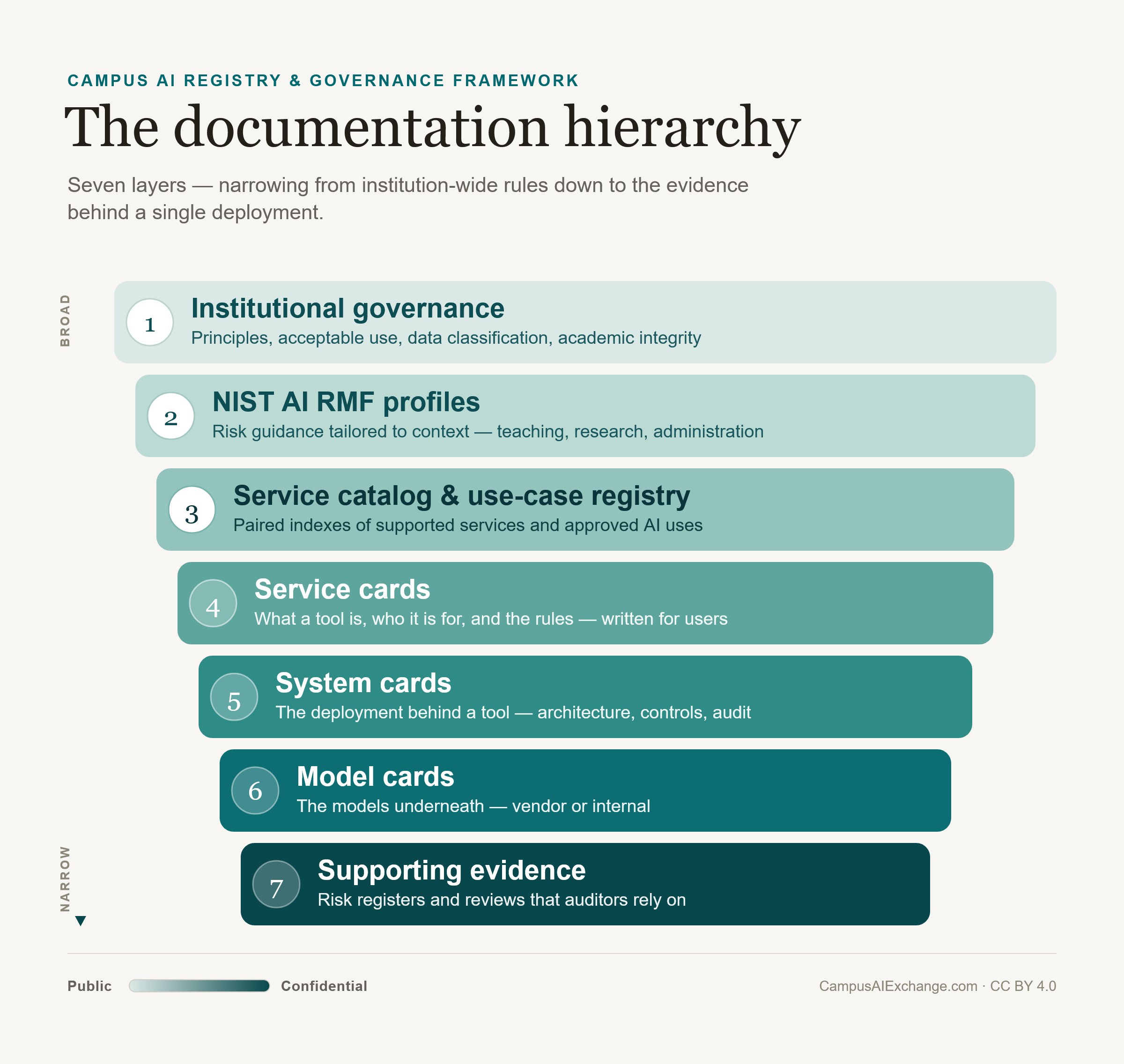
The documentation hierarchy: seven layers narrowing from institutional governance at the top to supporting evidence at the bottom, colored from light (Public) to dark (Confidential).
Seven layers, narrowing from institution-wide rules down to the evidence behind a single deployment.

Why this structure matters

Colleges and universities rarely have just one AI tool. They have institution-managed platforms, external suites, embedded enterprise AI, CRM and LMS tools, and local research environments. A layered structure keeps those different artifacts related instead of scattered.

What makes it distinctive

Most peers publish parts of this stack, especially guidance and tool catalogs. Fewer institutions connect those public artifacts to internal profiles, system cards, model summaries, and publication controls in one coherent framework.

Built from patterns that already exist

This framework is not speculative. It assembles documentation patterns found in pieces across higher education into a more complete institutional model.

Download the whitepaper See the peer patterns